Hey there! I’m a supplier of open cooling towers, and today I wanna chat about how to calculate the evaporation rate of an open cooling tower. It’s a crucial thing to know, whether you’re in the business of using cooling towers or selling em like me. Open Cooling Tower
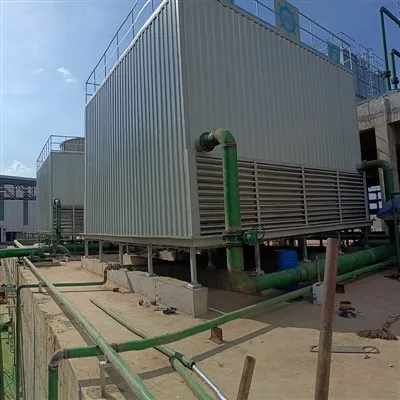
Why Calculate the Evaporation Rate Anyway?
First off, understanding the evaporation rate is super important. It helps in figuring out water consumption. In an era where water conservation is a big deal, having an accurate idea of how much water your cooling tower is using through evaporation can save you a ton of money and resources. It also affects the performance of the cooling tower. If the evaporation rate is too high or too low, it can mess with the cooling efficiency and even lead to problems like scale buildup and corrosion.
Factors Affecting Evaporation Rate
Before we dive into the actual calculations, let’s look at the factors that influence the evaporation rate of an open cooling tower.
1. Temperature
The temperature difference between the hot water entering the tower and the surrounding air is a major player. The bigger the difference, the higher the evaporation rate. For example, if you’re sending in water that’s really hot on a cool day, a lot more water is gonna evaporate as it cools down.
2. Humidity
Humidity is the amount of moisture in the air. When the air is already saturated with moisture (high humidity), it can’t take in as much evaporated water from the cooling tower. So, on a humid day, the evaporation rate will be lower compared to a dry day.
3. Airflow
The amount of air flowing through the cooling tower matters too. More airflow means more fresh, dry air can come in contact with the water, which helps in evaporation. That’s why cooling towers often have fans to increase the airflow.
4. Water Flow Rate
The rate at which water is flowing through the cooling tower also affects evaporation. If the water is flowing too fast, it might not have enough time to evaporate properly. On the other hand, if it’s flowing too slowly, it can lead to inefficiencies.
Calculating the Evaporation Rate
There are a couple of ways to calculate the evaporation rate, and I’m gonna share a common method.
The basic formula for calculating the evaporation rate (E) in an open cooling tower is:
$E = m_w\times C_p\times\Delta T / h_{fg}$
Let’s break this down:
-
$m_w$: This is the mass flow rate of the water through the cooling tower. You can measure this using flow meters or calculate it based on the system design. For example, if you know the volume flow rate ($Q$) of water in cubic meters per hour and the density of water ($ρ = 1000$ kg/m³), then $m_w=Q\timesρ$.
-
$C_p$: This is the specific heat capacity of water. For water, $C_p = 4.18$ kJ/(kg·°C). It’s the amount of energy needed to raise the temperature of 1 kg of water by 1°C.
-
$\Delta T$: This is the temperature difference between the inlet water temperature ($T_{in}$) and the outlet water temperature ($T_{out}$) of the cooling tower. So, $\Delta T=T_{in}-T_{out}$.
-
$h_{fg}$: This is the latent heat of vaporization of water. At atmospheric pressure, $h_{fg}= 2257$ kJ/kg. It’s the amount of energy needed to turn 1 kg of liquid water into vapor without changing its temperature.
Let’s say you have a cooling tower with a water flow rate of 100 m³/h. First, convert the volume flow rate to mass flow rate:
$m_w = 100$ m³/h $\times 1000$ kg/m³ = 100000 kg/h
Let’s assume the inlet water temperature is $40$°C and the outlet water temperature is $30$°C. So, $\Delta T = 40 – 30=10$°C
Now, use the formula:
$E=\frac{m_w\times C_p\times\Delta T}{h_{fg}}$
$E=\frac{100000 \text{ kg/h}\times4.18\text{ kJ/(kg·°C)}\times10\text{°C}}{2257\text{ kJ/kg}}$
$E=\frac{4180000\text{ kJ/h}}{2257\text{ kJ/kg}}\approx1852$ kg/h
Practical Considerations
In real – world situations, the calculation might not be as straightforward. There are some other things you need to keep in mind.
-
Heat losses: There will be some heat losses to the surroundings other than through evaporation. These losses can be due to conduction, radiation, etc. So, the actual evaporation rate might be slightly different from what you calculate using the formula.
-
Water quality: The quality of water can affect evaporation. If the water has a lot of dissolved solids or impurities, it can change the surface tension and other properties, which in turn can influence the evaporation rate.
-
Operating conditions: The cooling tower might not always operate under steady – state conditions. Variations in temperature, humidity, and airflow can occur throughout the day, which means the evaporation rate will also keep changing.
How This Helps You
As a potential buyer of an open cooling tower, knowing how to calculate the evaporation rate gives you a better understanding of the costs and efficiency of the system. You can compare different cooling towers based on their expected evaporation rates and make a more informed decision.

For those in industries that rely heavily on cooling towers, like power plants or manufacturing facilities, accurate calculation of the evaporation rate can help in better water management. You can plan for water replenishment, reduce water waste, and optimize the operation of the cooling tower.
Reach Out for More
Closed Circuit Cooling Tower If you’re interested in getting an open cooling tower for your business or just wanna learn more about evaporation rates and how they relate to cooling tower performance, I’d love to have a chat. Whether you’re looking for a small – scale cooling tower for a local facility or a large – scale solution for an industrial plant, we’ve got options. We can discuss your specific needs, do some custom calculations for the evaporation rate based on your operating conditions, and find the perfect cooling tower for you. So, don’t hesitate to reach out and start the conversation!
References
- Fundamentals of Heat and Mass Transfer by Incropera, DeWitt, Bergman, and Lavine
- Cooling Tower Handbook by American Tower Company.
Hainan Haizhou Fluid Technology Co., Ltd.
As one of the most experienced open cooling tower manufacturers and suppliers in China, we also support customized service. Please feel free to wholesale bulk high quality open cooling tower in stock here from our factory. Contact us for more details.
Address: Room 3003A-877, 30th Floor, Tower A, Internet Finance Building, No. 3 Guoxing Avenue, Lantian Subdistrict, Meilan District, Haikou City, Hainan Province
E-mail: FD@jxark.com
WebSite: https://www.hnhzark.com/
