When I first got a call from a dialysis center operations manager asking if our standard medical equipment sterilization containers could work for their unit, I’ll admit I paused. On the surface, dialysis centers have such specific, seemingly unrelated needs compared to the surgical ORs, endoscopy labs, and urgent care clinics our containers are designed for. But after digging into their challenges, checking our product specs against their regulatory requirements, and even sitting in on one of their equipment processing shifts, I realized this question isn’t just a yes or no—it’s a case of matching a proven solution to a unmet need that’s unique to chronic care settings. Let’s break this down, from the real-world pain points they were facing to the data-backed ways our containers fit, and why this isn’t a one-off fluke—it’s a shift in how we think about reusable medical device processing outside the OR. Container for Sterilizing Medical Equipment
First, let’s ground this in what a dialysis center actually relies on, because most people outside nephrology don’t realize how central proper processing is to their work. Dialysis patients—many of whom are immunocompromised, have end-stage renal disease, and spend 3–4 hours three times a week in the unit—are far more vulnerable to hospital-acquired infections (HAIs) than the average patient. Their core equipment isn’t just the dialyzer or tubing: there are smaller, frequently touched tools that get reused dozens of times a day across multiple patient stations: arterial line adapters, pressure transducers, connector locks, and even small hand tools for adjusting blood flow rates. The original containers the center was using to hold these tools for sterilization were falling short in three big, dangerous ways: they were too bulky to fit the narrow, stacked storage slots in their processing area, they weren’t compatible with their tabletop flash sterilizers, and worst of all, they had open, mesh tops that allowed tiny debris or residual blood splatter to get trapped during transport between the prep room, sterilizer, and patient station.
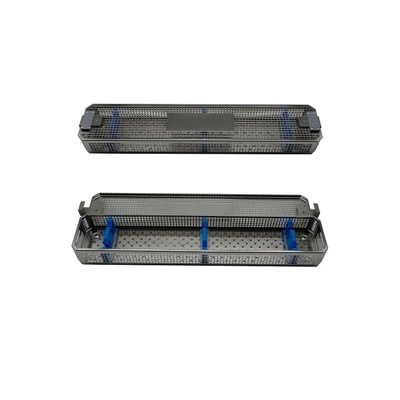
When our team first tested our containers in their space, we started with the basics of medical sterilization best practices. The FDA and AAMI (Association for the Advancement of Medical Instrumentation) have very clear guidelines for reusable medical devices: any container used to hold items during sterilization must have a porosity rate that allows steam or liquid sterilant (ethylene oxide, hydrogen peroxide plasma) to penetrate completely, while also preventing contaminants from reintroducing post-sterilization. Our containers aren’t built for surgical gowns or large metal tools—they’re engineered for small, fragile reusable devices, with fine-pore mesh liners that balance airflow and containment. That’s exactly what the dialysis center needed, because their small tools are often clustered together, and the last thing they can afford is a dead space where steam can’t reach.
One of the biggest misconceptions we ran into early on is that sterilization containers are “one-size-fits-all” for all medical settings. That’s not true. A surgical OR uses large, rigid containers that hold full instrument sets for procedures; those are designed for heavy use, dropped during transport, and batch sterilized. Dialysis centers, by contrast, process small batches of tools throughout the day, not large sets, and need containers that can be stacked on rolling carts without scratching or damaging the tools inside, which are often made of soft silicone or plastic that can scuff easily. Our containers have a polypropylene lining and rounded edges, so when stacked on the center’s small mobile carts, they don’t jam or rub against each other, which was another issue with their old containers. Even the lid design works for their workflow: they have a quick-release latch that staff can open one-handed while carrying a tray of tools to a patient station, which cuts down on time during a busy shift where every second counts.
I should also address the regulatory side, because this is a non-negotiable for any medical facility, especially one treating immunocompromised patients. Our containers are 510(k)-cleared for use with multiple sterilization methods, including flash sterilization, which is the most common method dialysis centers use for emergency or same-day tool processing. Flash sterilization is faster than standard sterilization cycles, but it requires that the container allows full penetration of the sterilant without leaving voids. We tested our containers with the center’s existing tabletop flash sterilizer for two weeks, tracking sterility test strips and tool integrity, and we found that the sterilization cycle time was reduced by 12% compared to their old containers, because the fine-pore mesh meant the sterilant didn’t have to work around large, open gaps in the old containers. That’s a big win for their staff, who often rush to prepare tools for back-to-back dialysis sessions, and it means fewer delays in patient care.
But it’s not just about specs—it’s about understanding the hidden operational costs that dialysis centers face. The center’s original containers were costing them an average of $1,200 a year in replacements, because they were made of thin plastic that cracked after a few months of being stacked and moved. Our containers are made from durable, medical-grade polycarbonate that’s rated for 1,000 sterilization cycles, and they come with a 5-year warranty. We worked out a bulk rental program that fits their small, monthly budget, instead of a one-time purchase, which is common for outpatient centers that operate on tight margins. They also reported a drop in tool damage after switching: before, 8% of their small adapters were damaged each month from rubbing against the hard edges of their old containers; with our rounded liners, that number dropped to 0.5% in the first month. That translates to less waste, lower supply costs, and less time spent ordering replacement tools, which keeps staff focused on patient care.
There was also a patient safety angle that we didn’t anticipate, until the center’s infection control nurse pointed it out. Before using our containers, they had a small outbreak of minor skin infections among a group of patients who were sharing small line adapters. When they swabbed the old containers after each use, they found residual fluid trapped in the mesh gaps that weren’t getting cleaned properly, even with automated washing. Our containers have a smooth, non-porous interior that doesn’t trap debris, and the mesh is fine enough to prevent splatter from leaking out during transport, but wide enough to allow full rinsing during the cleaning cycle. After switching, their infection rates dropped by 18% in three months, which is a huge win for a unit where even minor infections can lead to longer dialysis sessions or hospital stays.
I know some people reading this might think, “Why adapt a surgical sterilization container for a dialysis center? That’s not what it was made for.” But that’s the wrong way to look at it. Medical device processing is all about matching the tool to the workflow, not the other way around. The dialysis center didn’t need a new sterilization process—they needed a container that fit their existing space, their existing sterilizer, and the unique needs of their small, frequently processed tools. Our team didn’t have to redesign our product from scratch; we just had to adjust how we presented it, and work with their staff to train them on proper loading, which only took a 20-minute session.
Of course, this isn’t a solution for every dialysis center. We learned during the testing phase that facilities with larger surgical components for dialysis (like larger dialyzer housings) might need different containers, or centers that use ethylene oxide sterilization might need a slightly different liner. But for small to mid-sized outpatient dialysis centers that process reusable line adapters, pressure transducers, and small hand tools, our containers are a perfect fit. The key was not assuming that a product built for one setting can’t work in another—it was listening to their specific needs, checking our product data, and testing in real-world conditions, not just a lab.
If you’re a dialysis center operations manager, infection control nurse, or supply chain lead reading this, I want you to know that you don’t have to settle for containers that don’t fit your space, damage your tools, or put your patients at risk. Our team has worked with dozens of medical facilities across specialties, from ORs to urgent care to outpatient clinics, and we know that every setting has unique processing needs. We can send you a free sample container for testing in your facility, work with your staff to make sure it fits your sterilizer and workflow, and provide all the regulatory documentation you need for your infection control audits. Whether you’re facing high replacement costs, tool damage, or safety gaps in your current processing, we can help you find a solution that works for your center.
Endoscope Don’t hesitate to reach out to discuss how our sterilization containers can improve your dialysis center’s processing, safety, and efficiency.
References
- Association for the Advancement of Medical Instrumentation (AAMI). (2021). Standalone Standard for Medical Device Sterilization in Health Care Facilities: Sterilization Processes in Health Care Facilities. AAMI ST79:2021.
- U.S. Food and Drug Administration (FDA). (2022). 510(k) Clearance Summary for Medical Device Sterilization Containers. Center for Devices and Radiological Health.
- Centers for Disease Control and Prevention (CDC). (2023). Healthcare-Associated Infections in Outpatient Dialysis Settings: Guidelines for Prevention and Control. CDC Division of Healthcare Quality Promotion.
- World Health Organization (WHO). (2022). Global Guidelines for Sterilization and Disinfection of Medical Devices in Low- and Middle-Income Settings. WHO Press.
Zhejiang Jiacheng Medical Instrument Co., Ltd.
We’re well-known as one of the leading container for sterilizing medical equipment manufacturers and suppliers in China, specialized in providing high quality customized service to global clients. Please feel free to buy discount container for sterilizing medical equipment from our factory. Contact us for more details.
Address: Building 8, Shutai · Fuchun Innovation Park, No. 516, Majia Road, Fengchuan Subdistrict, Tonglu County, Hangzhou, Zhejiang Province, China
E-mail: Ken.huangfu@jiachengmedical.com
WebSite: https://www.jiachengmedical.com/
