When I hear someone ask, “What is the yield strength of EN High Strength Steel Plate?” I don’t just reach for a spec sheet— I reach for the actual steel we stock in our warehouse, the plates we’ve tested three times before they leave our loading docks, and the conversations we’ve had with structural engineers who rely on these numbers to build bridges, crane booms, and offshore platforms that won’t bend under pressure. For anyone working with steel, yield strength isn’t just a technical detail; it’s the line between a job done right and a disaster waiting to happen. As a supplier of EN high strength steel plate, I get asked this question at least once a week, and the answer isn’t as straightforward as a single number. Let’s break it down, the way I break it down for engineers and fabricators who call me looking for clarity. EN High Strength Steel Plate
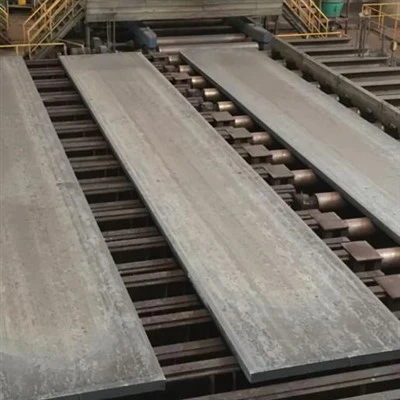
First, let’s start with the basics: what does “EN High Strength Steel Plate” even mean? EN stands for European Norms, the set of standards that govern steel manufacturing across the European Union and many other countries. High strength steel, in this context, isn’t just any steel that’s thicker than a standard plate—it’s a category of steels engineered to have higher tensile strength, better toughness, and often better weldability than ordinary carbon steel. The yield strength is the point where the steel stops being elastic (meaning it bends and returns to its original shape) and starts being plastic (meaning it stays bent, permanently deformed). For applications like lifting cranes or bridge girders, that permanent deformation is a failure. So yield strength is non-negotiable.
Now, the key point: there’s no single yield strength for all EN high strength steel plates. It depends entirely on the grade. The most common grades we supply are S355, S460, S690, and S960. Each of these has a minimum yield strength that’s tested under specific conditions, and that’s where most of the confusion comes in. For example, S355 is often called “workhorse high strength steel” because it’s versatile, used in everything from farm equipment to building frames. Its minimum yield strength—when the plate thickness is 16mm or less, a common size—stands at 355 megapascals (MPa). But here’s the catch: if the plate is thicker, say, over 40mm, that minimum drops. For S355 plates 40mm to 63mm thick, the yield strength minimum is 345 MPa, and for plates over 63mm, it’s 335 MPa. Thickness matters because thicker steel is harder to produce consistently, so its yield strength can be slightly lower to ensure reliability.
Next up is S460, a grade we often recommend for projects that need more strength without adding extra weight—think of a crane boom that can lift 50 tons but has to stay light enough to move. S460’s minimum yield strength is 460 MPa for plates up to 16mm thick, 450 MPa for plates 16 to 40mm, and 440 MPa for plates over 40mm. I remember a customer a couple of years back, a contractor building a temporary bridge for a construction site, who used S460 plates because they needed to span 20 meters without sagging. He initially asked for S355, but when we explained that the S460’s higher yield strength would let him use thinner plates, saving on both material and installation time, he switched and saved nearly 15% on his material costs. That’s the kind of practical difference knowing the right yield strength makes.
Then we get to the higher grades: S690 and S960. These are ultra-high strength steels, used in heavy machinery, offshore oil rig components, and military equipment where extreme strength is non-negotiable. S690’s minimum yield strength is 690 MPa for plates up to 16mm, and 670 MPa for plates over 16mm. S960, the strongest of the common EN grades we stock, has a minimum yield strength of 960 MPa for thinner plates, dropping to 900 MPa for thicker ones. I’ve only worked with a handful of S960 projects in the last 10 years—one was for a offshore wind turbine foundation that needed to withstand 100-ton loads and saltwater corrosion. The engineer who specified it told me that without that 960 MPa yield strength, the foundation would have needed twice as much steel, making the project impossible to build on site.
A lot of first-time buyers mix up yield strength with tensile strength, so I always clarify that difference too. Yield strength is the bend point; tensile strength is the point where the steel breaks. For example, S355 has a tensile strength of 470 to 630 MPa, so it will start bending at 355 MPa before it ever breaks. That’s intentional—we want steel to bend, not break, in most structural applications. If a plate reached tensile strength before yield, it would snap without warning, which is dangerous. EN standards make sure that all high strength steel plates we supply follow this balance.
Another factor that affects yield strength: the steel’s heat treatment. Most EN high strength plates are either quenched and tempered (Q&T) or normalized. Quenched and tempered steels are heated then rapidly cooled, which makes them much stronger—this is where S690 and S960 come from. Normalized steels are cooled slowly, which makes them more ductile, a better fit for welding projects where the steel might be modified on site. I always ask customers what kind of welding or cutting they’re doing before recommending a grade, because a high yield strength doesn’t help if the steel cracks when you weld it. For example, S690 has great yield strength, but it needs preheating before welding to avoid cracking—something I’ll remind every customer about before they place their order.
Testing is another part of this that I don’t cut corners on. When we get a shipment of EN high strength steel plates, we test a random sample from each batch for yield strength. We use a universal testing machine that applies pressure until the plate bends, and we record exactly where that happens. If a batch comes back lower than the EN standard’s minimum yield strength, we send it back to the mill—no exceptions. A few years ago, we had a small batch of S460 plates that came back with a yield strength of 445 MPa, 5 MPa below the required 450 MPa for plates 16 to 40mm. We flagged it immediately, even though the difference was tiny, because I won’t put my name on steel that doesn’t meet the EN specs. That’s why customers come back to us—they know every plate we ship has been tested, not just stamped.
I also get questions about working at temperatures below zero, like for Arctic pipeline projects. EN high strength steel plates are rated for impact toughness at different temperatures, and that affects their yield strength too. For example, S355JR has a minimum impact toughness at room temperature, but S355NL has that toughness at -50°C, so its yield strength is still consistent even in cold weather. If a customer is working in Alaska or northern Canada, I’ll make sure they get the “NL” grade instead of the standard JR, because the yield strength doesn’t drop when temperatures do—something that would cause a failure in freezing conditions.
Let’s talk about common mistakes I see buyers make. A fabricator once called me, panicking because he ordered S355 plates for a crane arm that needed to hold 80 tons, and the arm bent under half that load. He’d ordered the right yield strength number, but he’d ordered plates 80mm thick, which had a yield strength of 335 MPa instead of 355 MPa. That’s a small thickness difference but a big strength difference. I explained that he needed S460 plates, which would give him 440 MPa for that thickness, and that switching would let him use a thinner plate that was still stronger, saving him from having to redo the entire crane arm. That’s why I always ask for the project’s loading requirements, the thickness they need, and the operating environment before I even quote a price—those details matter more than just the grade name.
So, to circle back to the original question: there’s no single yield strength for EN high strength steel plate, but there is a clear breakdown by grade and thickness. For the workhorse grade S355, it’s 355 MPa for plates under 16mm, 345 MPa for 16 to 40mm, 335 MPa for over 40mm. For S460, it’s 460 MPa, 450 MPa, 440 MPa. For S690, it’s 690 MPa, 670 MPa, and for S960, it’s 960 MPa, 900 MPa. Those numbers are non-negotiable—they’re set by EN standards, tested at the mill, and verified by us before shipping.
If you’re a structural engineer, fabricator, or project manager trying to pick the right EN high strength steel plate, don’t just look at the grade number. Think about your project’s load, the thickness you need, the operating temperature, and whether you’ll be welding the plate. If you’re not sure, that’s what I’m here for. As a supplier who’s been in this business for 12 years, I don’t just sell plates—I give advice that keeps projects safe, on budget, and built to last. I’ve seen too many projects go wrong because someone guessed at yield strength instead of checking the specs, and I never want that to happen to a customer who comes to me for help.

If you’re planning a project that requires EN high strength steel plate, whether it’s a small farm equipment build or a large offshore structure, let’s talk. I can send you test certificates for any grade we stock, explain the difference between thicknesses and heat treatments, and help you pick the right plate that fits your needs and your budget. You don’t have to sort through the specs alone—just reach out, and we’ll go over every detail so you know exactly what yield strength you’re getting, and why it matters for your project.
JIS Corten Steel References
- European Committee for Standardization. (2019). EN 10025-2: Hot-rolled steel products for structural purposes – Part 2: Non-alloy structural steels. Brussels, Belgium: CEN.
- European Committee for Standardization. (2020). EN 10025-3: Hot-rolled steel products for structural purposes – Part 3: Normalized and normalizing-rolled fine grain steels. Brussels, Belgium: CEN.
- European Committee for Standardization. (2021). EN 10025-6: Hot-rolled steel products for structural purposes – Part 6: High yield strength structural steels, quenched and tempered. Brussels, Belgium: CEN.
- Dieter, G. E. (1986). Mechanical Metallurgy (3rd ed.). McGraw-Hill Education.
- Callister, W. D., & Rethwisch, D. G. (2018). Materials Science and Engineering: An Introduction (10th ed.). John Wiley & Sons.
Gnee Steel (Tianjin) Co., Ltd.
As one of the most professional en high strength steel plate manufacturers and suppliers in China, we also support customized service with low price. We warmly welcome you to buy high quality en high strength steel plate in stock here from our factory. If you have any enquiry about free sample, please feel free to email us.
Address: No.4-1114, Beichen Building, Beicang Town, Beichen District, Tianjin, China
E-mail: alloy@gneesteelgroup.com
WebSite: https://www.chinavesselplates.com/
